
SWAMI RAMA HIMALAYAN UNIVERSITY
Swami Ram Nagar, Jolly GrantDehradun - 248016, Uttarakhand, India
MBA Skills in the AI Era: What Will Make Management Professionals Stand Out in 2026?
Admin
October 19, 2026
Career Guide
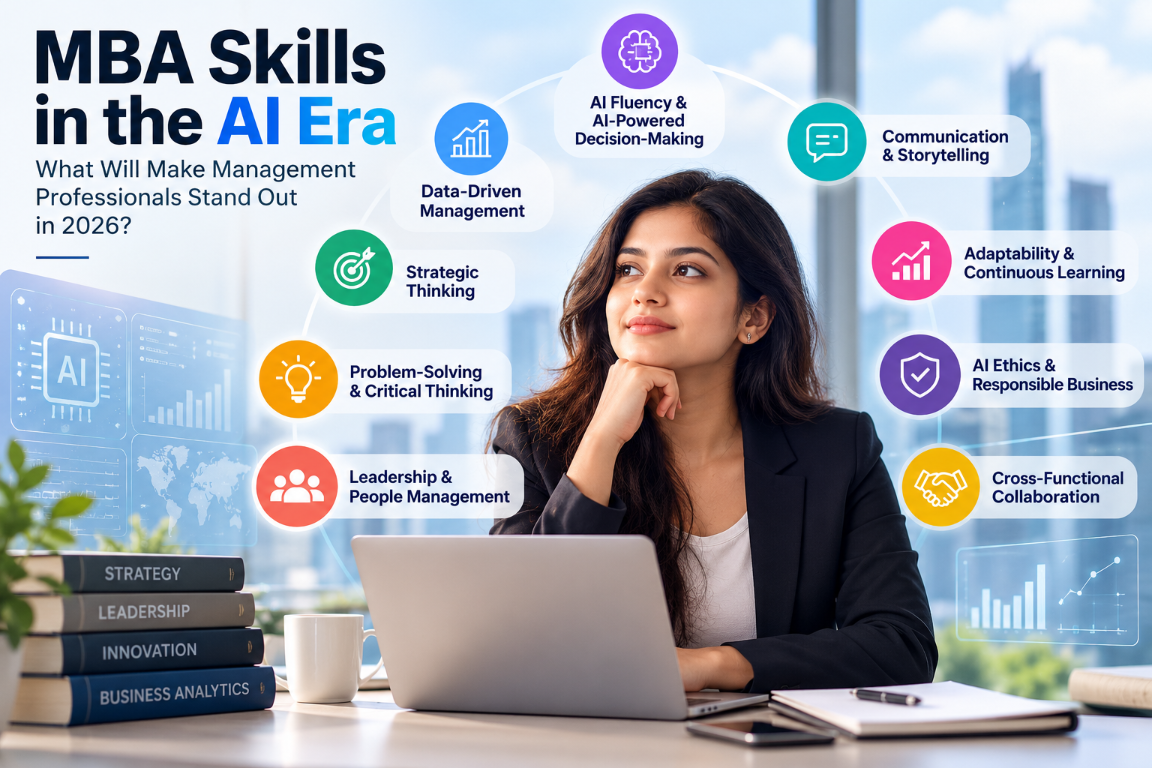
Management professionals who stand out in 2026 combine fluency with AI tools with distinctly human judgement. That means communication, critical reasoning, adaptability and the ability to lead people through change. Employers no longer reward graduates for producing analysis that software can generate in seconds. They reward the ability to question that analysis, decide on it and persuade others to act.
The evidence from global recruiters and Indian employers points in the same direction. MBA skills in 2026 are defined less by what a graduate knows and more by how well they blend machine output with business context, ethics and stakeholder insight.
For anyone weighing a management degree, the real question has shifted. It is no longer whether an MBA remains relevant, but which skills for MBA students will keep their value once routine analytical work is automated. The sections that follow answer that question through current recruiter data, an original capability model, the roles that are expanding, and the programme features that genuinely prepare learners for AI-driven workplaces.
Table of Contents
- What Hiring Data Reveals About the Changing Manager
- What It Means to Be AI-Literate in Management
- The DRIVE Model: Five Capabilities of the AI-Era Manager
- Seven Capabilities That Separate Leading Candidates
- Conventional Management Strengths vs AI-Era Expectations
- Where These Capabilities Lead: Expanding Management Roles
- Specialisations That Build AI-Ready Management Capability
- The Road Ahead and How to Judge a Programme's Readiness
- Frequently Asked Questions
What Hiring Data Reveals About the Changing Manager
AI is not reducing the demand for management talent. It is changing what that talent is expected to do. Recent global and Indian research shows a clear pattern of rising technical expectations alongside a renewed premium on human capability.
Key trends shaping management careers
Human skills lead today's hiring decisions. In GMAC's 2026 Corporate Recruiters Survey of 621 recruiters across 39 countries, communication, problem-solving and adaptability were the capabilities employers weigh most when hiring business school graduates.
AI capability is the skill of the next five years. Skills using AI tools rank 14th among current priorities at 50% of employers, yet recruiters project them as the single most important skill five years ahead (GMAC survey summary) . Strategic thinking and decision-making also rise in that forward view.
Entry-level work is being redesigned. One in three employers report having replaced some entry-level roles with AI, according to the same survey. Tasks such as data entry, routine coding and basic customer service are the most affected.
A readiness gap is visible. Employers rate AI capability among the skills graduates are least prepared to demonstrate, along with grit, emotional intelligence and managing people.
Indian roles are being rewritten. A Nasscom–Indeed report found that 86% of Indian employers have seen AI change job roles, and 35% describe that change as significant. Some 63% report year-on-year growth in hiring for AI-related roles, led by BFSI and telecommunications.
Demonstrable skills are becoming hiring signals. The same report notes that 40% of Indian employers now prefer demonstrable AI skills or certifications over degrees alone, while 32% weigh skills, certifications and degrees equally.
India's AI talent gap is widening. The BinQle Talent Intelligence Report estimates India may need around 1.4 million AI professionals in 2026 against a pool of roughly 400,000.
Analytical thinking remains the anchor. The World Economic Forum's latest Future of Jobs Report lists analytical thinking as the top core skill for seven in ten employers, with AI and big data the fastest-growing skill area.
Read together, these signals define the future skills for MBA graduates as a hybrid profile. Technical fluency has become a baseline expectation, while judgement, communication and leadership determine who advances. Confidence in the degree itself remains strong: every employer in the GMAC survey expressed some level of trust in graduate management education and the value its graduates bring.
What It Means to Be AI-Literate in Management
AI literacy in management is the ability to understand what AI systems can and cannot do, apply them to real business problems, evaluate their outputs critically and govern their use responsibly. It is a managerial competence, not a programming qualification. A marketing head who can brief an AI-driven campaign tool, test its assumptions and explain its results to the board is AI-literate, even without writing a line of code.
AI literacy for MBA students typically spans five capabilities:Conceptual understanding: how machine learning, generative AI and AI agents work at a functional level, and where each fits in a business process.
Applied use: using AI tools for research, forecasting, content, customer insight and process automation.
Output evaluation: checking AI-generated analysis for errors, bias, missing context and fabricated information.
Workflow redesign: identifying which tasks to automate, which to augment and which must stay human-led.
Responsible governance: applying data privacy rules, including India's Digital Personal Data Protection framework, along with fairness, transparency and accountability standards.
Why this literacy matters
Managers increasingly approve AI investments, so they must judge vendor claims and expected returns.
AI errors carry reputational and regulatory risk, and accountability for them sits with business leaders, not software.
Teams look to managers to explain how AI changes their roles, which requires both understanding and empathy.
Recruiters treat applied AI capability as a differentiator precisely because few graduates can yet demonstrate it convincingly.
The DRIVE Model: Five Capabilities of the AI-Era Manager
The DRIVE Model is an original framework that organises AI-era management capability into five connected domains. It reflects the hybrid profile that recruiters describe: technical fluency is necessary, but value is created when that fluency is directed by judgement, communication and ethical leadership.
| Pillar | What it means | How it shows up at work |
|---|---|---|
| D – Data Fluency | Reading, questioning and interpreting data; knowing which metric answers which business question | Spotting a misleading dashboard before it shapes a budget decision |
| R – Reasoned Judgement | Weighing evidence, testing assumptions and deciding under uncertainty | Rejecting an AI-generated forecast built on outdated market conditions |
| I – Intelligent Tool Orchestration | Selecting and combining AI tools and agents to automate or augment work | Redesigning a reporting process so analysts spend time on insight, not compilation |
| V – Value Communication | Turning analysis into a clear narrative that moves stakeholders to act | Presenting a pricing recommendation that wins sign-off from finance and sales |
| E – Ethical and Empathetic Leadership | Governing AI responsibly and leading people through change | Introducing an AI tool while protecting customer data and retraining affected staff |
The model's central insight is that the pillars multiply rather than add. A graduate strong in Intelligent Tool Orchestration but weak in Reasoned Judgement produces faster errors, not better decisions. The strongest business skills for MBA students sit at the intersections, such as data read with judgement or AI output communicated with context.
Applying the DRIVE Model
As a self-assessment: rating each pillar on a scale of 1 to 5 reveals which capabilities need deliberate development before graduation or a career move.
As a programme filter: a curriculum that develops only one or two pillars, for example, tools without leadership, is unlikely to prepare learners for management roles.
As an interview narrative: describing one project per pillar gives recruiters concrete evidence of the hybrid profile they report struggling to find.
Seven Capabilities That Separate Leading Candidates
The capabilities below carry the most weight with employers right now. Each maps to one or more pillars of the DRIVE Model.
1. Critical Thinking and Output VerificationAI tools produce confident answers, but confidence is not accuracy. Critical thinking for MBA students now includes interrogating machine-generated analysis: checking data sources, testing assumptions, spotting bias and recognising when a plausible answer is simply wrong. This is the skill that keeps automation from turning small errors into costly decisions.
2. Decision-Making Under UncertaintyAI can model scenarios, but it cannot own consequences. Business decision making skills involve framing the right question, weighing trade-offs between cost, risk and stakeholder impact, and committing to a course of action with incomplete information. GMAC's recruiters list decision-making among the skills set to grow in importance over the next five years.
3. Applied AI CapabilityAI skills for MBA students focus on business application rather than engineering. They include structured prompting, AI-assisted forecasting and research, no-code automation, working with AI agents, and evaluating AI vendors and use cases. The Nasscom–Indeed report names generative AI and prompt engineering, along with data analytics and visualisation, among the most demanded skills across Indian industries.
4. Data Storytelling and Persuasive CommunicationCommunication remains the most valued skill among recruiters today. As AI generates more reports, the scarce capability becomes turning findings into a concise, credible story that leadership can act on.
5. Adaptability and Learning AgilityTools will keep changing faster than any curriculum. Professionals who can learn a new platform quickly, adjust their methods and remain productive through disruption hold a durable advantage.
6. People Leadership and Emotional IntelligenceAI changes roles, and people need guidance through that change. Recruiters report shortages in emotional intelligence and managing human capital, making these skills a clear differentiator.
7. Strategic and Systems ThinkingUnderstanding how a decision in one function affects customers, operations, and finance is difficult to automate. Strategic thinking ranks among the top skills recruiters expect to value most in five years.
Advantages of building this combined skill set
Resilience to automation: roles anchored in judgement and leadership are the least exposed to replacement.
Faster career progression: professionals who can direct AI rather than compete with it are positioned for supervisory responsibility earlier.
Cross-industry mobility: these capabilities transfer across BFSI, consulting, technology, manufacturing, healthcare and retail.
Stronger return on education: a degree that builds both human and technical capability stays relevant as tools change.
Entrepreneurial readiness: AI lowers the cost of starting a venture, rewarding founders who combine tool fluency with business judgement.
Conventional Management Strengths vs AI-Era Expectations
The shift is not a replacement of traditional management skills but a change in where each skill creates value. The comparison below shows how expectations have moved.
| Dimension | Conventional emphasis | AI-era expectation |
|---|---|---|
| Analysis | Building spreadsheets and reports manually | Directing AI tools and validating their outputs |
| Decision-making | Experience-led judgement | Evidence-led judgement that tests machine recommendations |
| Communication | Presenting completed analysis | Translating complex, AI-generated insight into action |
| Technology | Proficiency in standard office software | Fluency with generative AI, analytics platforms and AI agents |
| Leadership | Managing teams and targets | Leading people through role redesign and continuous change |
| Ethics and risk | Compliance as a separate function | Responsible AI and data privacy built into everyday decisions |
| Learning | A degree as a one-time credential | Continuous upskilling, with certifications as proof of capability |
| Early-career work | Routine analysis as a training ground | Higher-value tasks earlier, as AI absorbs routine work |
The final row carries the most practical weight for early-career learners. With AI taking over many entry-level tasks, graduates are expected to contribute judgement sooner, which raises the value of programmes offering live projects, internships and applied case work.
Where These Capabilities Lead: Expanding Management Roles
AI is creating management roles that sit between technology teams and business outcomes. These positions reward the hybrid profile described above and are expanding across Indian corporates, global capability centres (GCCs), consulting firms and start-ups.
| Job role | Core responsibility |
|---|---|
| AI Product Manager | Defines and launches AI-powered products, balancing user needs, feasibility and business value |
| Business Analytics Manager | Leads teams that turn data into decisions on pricing, demand and performance |
| AI Strategy Consultant | Advises organisations on where and how to adopt AI for measurable returns |
| Digital Transformation Manager | Redesigns processes and operating models around AI and automation |
| AI Governance and Risk Manager | Oversees responsible AI, data privacy compliance and model risk |
| Marketing Analytics and Growth Manager | Uses AI-driven customer insight to plan campaigns and allocate budgets |
| Supply Chain Analytics Manager | Applies AI forecasting to inventory, logistics and procurement |
| FinTech Product or Risk Manager | Builds AI-enabled lending, payments or fraud solutions in BFSI |
| People Analytics and HR Technology Lead | Uses workforce data and AI tools for hiring, retention and reskilling |
| Customer Experience Strategy Manager | Designs AI-supported service journeys while protecting customer trust |
| Operations Excellence Manager | Improves productivity by combining automation with process redesign |
| Entrepreneur or Venture Founder | Builds lean, AI-enabled businesses with smaller founding teams |
Product management deserves particular attention.
Why these roles matter for long-term careers
They sit close to strategic decisions, offering visibility to senior leadership.
They are difficult to automate because they combine technical oversight with human judgement.
They exist across sectors, so the skills remain portable through industry cycles.
Demand is outpacing supply in India, strengthening negotiating power for qualified candidates.
Specialisations That Build AI-Ready Management Capability
Not every management programme develops all five DRIVE pillars equally. The specialisation chosen shapes which capabilities are built most deeply and which roles become most accessible.
Ready to lead where strategy meets algorithms? SRHU Online MBA pathway turns today's most-wanted capabilities into tomorrow's leadership advantage.
Specialisations aligned with AI-driven workplaces
Business Analytics: builds Data Fluency and Reasoned Judgement for analytics, consulting and strategy roles.
Artificial Intelligence and Machine Learning for Business: develops applied AI capability, use-case evaluation and AI product thinking.
Digital Transformation: focuses on process redesign, change management and technology-led operating models.
Product Management: combines customer insight, AI-enabled product design and cross-functional leadership.
FinTech: applies AI to lending, payments, risk and compliance in the BFSI sector, India's leading AI hiring segment.
Marketing Analytics: pairs consumer behaviour with AI-driven segmentation, personalisation and campaign measurement.
Operations and Supply Chain Analytics: uses AI forecasting and optimisation for manufacturing, logistics and e-commerce.
Human Resource Analytics: prepares learners to lead workforce planning and reskilling in AI-transformed organisations.
Delivery format matters as much as specialisation. Full-time programmes suit graduates seeking immersive learning and campus placements. Online and executive formats suit working professionals who need to apply new skills on the job while studying. GMAC's survey notes growing employer recognition of online programmes, with consulting the main exception, which makes a properly recognised online degree a credible option for many career paths.
The Road Ahead and How to Judge a Programme's Readiness
Over the next five years, AI is expected to move from a tool managers use to a layer embedded in nearly every business process. Agentic AI systems that complete multi-step tasks will make workflow design and oversight core managerial responsibilities. Regulation around data privacy and responsible AI will also mature, increasing demand for leaders who can balance innovation with accountability.
Outlook for management professionals
Skill half-lives will shorten: continuous learning will matter as much as the initial degree.
Hybrid roles will multiply: most management positions will require some level of AI oversight.
Human capabilities will gain value: as technical skills become widespread, judgement, communication and leadership will separate candidates.
India's position will strengthen: the expansion of GCCs and AI services is likely to keep demand for AI-capable managers ahead of supply.
Choosing a programme is therefore a decision about which capabilities will be built, not only which credential will be earned.
The best time to future-proof a management career is before the next wave of change arrives. Starting an MBA journey from SRHU Dehradun with a clear checklist makes that decision sharper and safer.
What to evaluate in a programme
Recognition and accreditation: approval from the University Grants Commission (UGC), AICTE where applicable, NAAC accreditation, and standing in NIRF rankings. For online degrees, UGC entitlement to offer the programme online.
AI across the curriculum: AI and analytics integrated into finance, marketing, operations and HR courses, not confined to a single elective.
Hands-on tool exposure: structured practice with generative AI, analytics and automation platforms used in industry.
Applied learning: live projects, capstones, internships and case studies built on real business problems.
Faculty depth: a balance of academic credentials and recent industry experience in AI-led transformation.
Human skill development: deliberate training in communication, leadership, negotiation and ethics.
Career support and outcomes: placement data, recruiter partnerships, alumni networks and mentoring.
Flexibility and support: learning formats, academic support and financing options that fit personal and professional circumstances.
Frequently Asked Questions
What skills should I learn in the AI era?
The most valuable combination pairs practical AI capability with human judgement. On the technical side, this means using generative AI tools, interpreting data and automating routine tasks. On the human side, it means critical thinking, communication, adaptability and leadership. Global recruiters currently rank communication as the top hiring skill while expecting AI tool proficiency to lead within five years.
Which MBA is best for AI?
The strongest choice is a recognised programme with a specialisation in Business Analytics, Artificial Intelligence for Business or Digital Transformation, where AI is also embedded across core courses. Hands-on tool exposure, live projects and faculty with industry experience matter more than the programme title. The right specialisation also depends on the intended career, such as product management, consulting or FinTech.
Will AI reduce the need for MBA graduates?
Current evidence suggests AI is reshaping MBA roles rather than reducing demand. One in three employers in GMAC's 2026 survey has replaced some entry-level tasks with AI, yet every employer surveyed expressed confidence in graduate management education. Demand is shifting towards graduates who can direct AI tools, interpret their outputs and lead teams through change.
Why is critical thinking important for MBA students?
AI produces fluent, confident answers that can still be incomplete, biased or wrong. Critical thinking allows managers to test assumptions, verify sources and recognise when a recommendation does not fit the business context. As decisions grow faster and more data-driven, this capability protects organisations from costly errors.
How can MBA students prepare for AI-driven workplaces?
Preparation works best on three tracks at once. The first is building applied AI capability through coursework, certifications and projects. The second is strengthening communication, leadership and ethical judgement through presentations, team assignments and case discussions. The third is gaining real-world exposure through internships and live projects, building a portfolio that demonstrates each skill with evidence.